
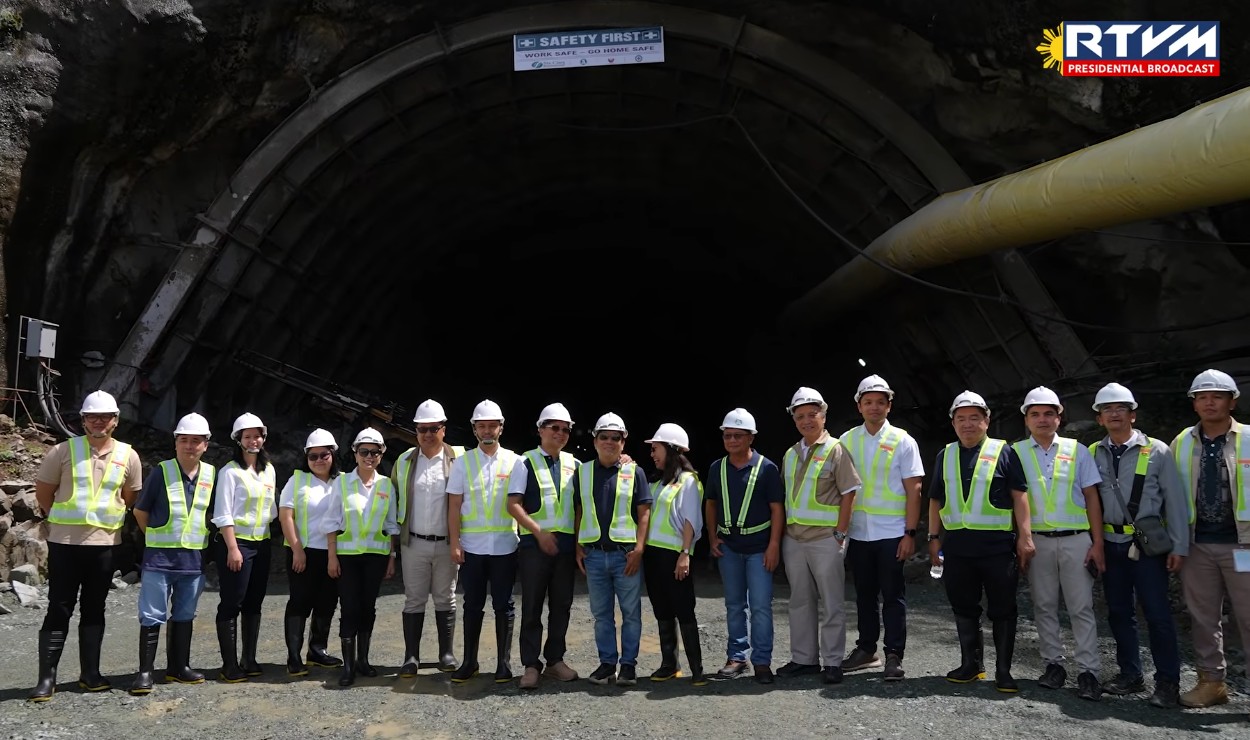
President Ferdinand R. Marcos Jr. has directed the National Irrigation Administration (NIA) to fast-track the Balog-Balog Multi-Purpose Project (BBMP) Phase II, a P20.544-billion infrastructure project that is expected to irrigate 34,410 hectares of farmland, benefit 21,776 farmers, and generate 43.5 megawatts of renewable energy in Central Luzon.
Representing the President, NIA Administrator Eduardo “Eddie” G. Guillen led the site inspection of the project site in Barangay Maamot, San Jose, Tarlac, and reiterated the administration’s commitment to completing the long-delayed project.
“The mindset of the President is not the color of politics, but what is most important is the benefits for the interest of the people,” Guillen said.
He stressed that the government’s focus is on nation-building and delivering projects that directly improve the lives of farmers and rural communities.
Guillen also described the Balog-Balog project as one of the most complex undertakings of the irrigation agency.
“Sa lahat ng project ng NIA, iyong Balog-Balog ang pinakamahirap,” he said, citing the construction of two diversion tunnels and engineering features designed to withstand major earthquakes.
According to NIA, the project traces its roots to a World Bank-funded feasibility study conducted from 1978 to 1980 to support agricultural development in Central Luzon. It was approved by the National Economic and Development Authority (NEDA) in 1988 with a project cost of P2.712 billion, including an $85-million loan from the Italian government.
However, the 1991 eruption of Mt. Pinatubo severely damaged project facilities, buried portions of the service area under volcanic ash, and disrupted foreign financing, prompting the government to restructure the undertaking into two phases.
Phase I, implemented from 1999 to 2012, restored and improved irrigation service to 12,475 hectares and benefited 7,340 farmers in Tarlac. The phase also rehabilitated irrigation facilities, upgraded sections of the North Main Canal, improved the Conveyance Canal and SMORIS irrigation systems, and raised the Tarlac Diversion Dam Ogee structures.
Phase II aims to expand irrigation coverage by an additional 21,935 hectares, bringing the total service area to 34,410 hectares and increasing the number of beneficiaries to 21,776 farmers across Central Luzon.
The project includes the construction of the Balog-Balog Dam and appurtenant structures with a water storage capacity of 559 million cubic meters, 313.10 kilometers of irrigation canals and drainage facilities, a 150-hectare fishery component, and a 43.5-megawatt hydropower facility.
NIA reported that overall physical accomplishment has reached 45.79 percent. Of the targeted 313.10 kilometers of irrigation canals and drainage facilities, 231.4 kilometers have already been completed.
The agency also reported significant progress in institutional and social development components. A total of 87 irrigators’ associations have been organized, surpassing the target of 85 associations.
Under the resettlement program, 531 affected families have been successfully relocated, while 455 of the targeted 699 core housing units have been completed.
NIA said the resettlement sites have been equipped with community facilities, including roads, drainage systems, schools, a barangay hall, day care center, health center, market, basketball court with stage, barangay outpost, botika, and cemetery. Water supply assistance and power subsidies have also been provided to relocated residents.
Also present during the inspection were Tarlac 2nd District Rep. Maria Cristina “Cristy” Puno-Cuello Angeles, San Jose Mayor Romeo G. Capitulo, Office of the Executive Secretary Undersecretary Erwin D. Sta. Ana, National Commission on Indigenous Peoples Chairperson and Secretary Nancy A. Catamco, and representatives of farmers’ groups and irrigators’ associations. | PND
Source: PCO