
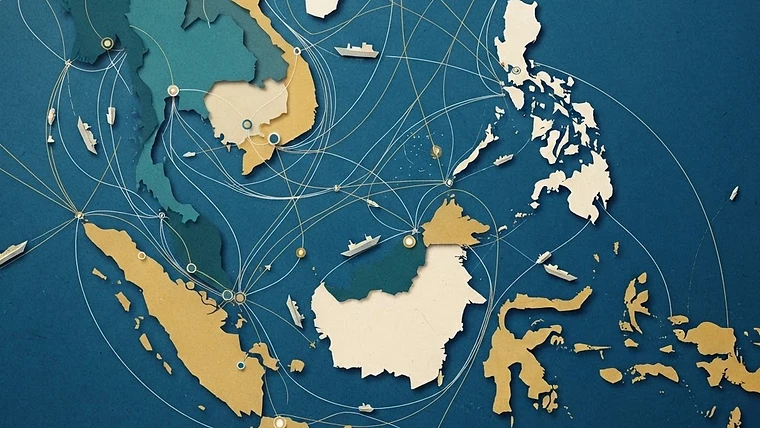
Southeast Asia is sometimes described as a region caught between larger powers. That description captures part of its geopolitical challenge, but it overlooks the region's own economic and strategic importance.
The countries of Southeast Asia sit along major maritime routes connecting the Indian and Pacific Oceans. They are part of global manufacturing networks, important sources of commodities, and increasingly significant markets for technology, finance, and consumer goods.
The region is not simply a corridor through which other countries move. It is a place where global economic and political interests meet.
A strategic geography
The waters around Southeast Asia carry substantial volumes of international trade. The Strait of Malacca, for example, is one of the world's most important maritime passages, connecting the Indian Ocean with the South China Sea and the wider Pacific.
This geography gives the region significance for shipping, energy security, and the movement of manufactured goods. Disruptions to major sea routes can affect supply chains far beyond Asia.
A growing role in manufacturing
Southeast Asian economies are connected to production networks that span multiple countries. Components may be designed in one country, manufactured in another, assembled elsewhere, and sold around the world.
Vietnam, Malaysia, Thailand, Singapore, and Indonesia each occupy different positions in these networks. The Philippines also contributes through electronics manufacturing, business services, and other industries.
Companies seeking to diversify supply chains have increased attention on the region. But attracting investment is only the beginning. Countries also need skilled workers, reliable electricity, efficient logistics, predictable regulations, and strong institutions.
Diplomacy without simple choices
Southeast Asian governments maintain relationships with the United States, China, Japan, South Korea, India, Europe, and one another. Their economic and security interests do not always point in the same direction.
ASEAN provides a framework for regional dialogue and cooperation, although its members have different priorities and approaches to international disputes.
The region's agency
It is easy to discuss Southeast Asia only through the competition between Washington and Beijing. Yet the region's long-term influence will also depend on its own choices: how it develops industries, manages natural resources, invests in people, and cooperates across borders.
For Filipinos, understanding Southeast Asia is not optional background knowledge. The region's trade routes, investment decisions, security relationships, and economic policies have direct implications for jobs, prices, and the country's position in the world.


